Daily Shaarli
February 21, 2020
"the meme gives Internet users a clear opportunity to think critically about shallow references to the Nazis or the Holocaust. And it exposes glib Nazi comparisons or Holocaust references to the harsh light of interrogation."
not due to the meme's fault, but due to incessant glib and spurious invocation of Nazis, have all modern comparisons, however thoughtful, lost all ability to be taken seriously and lead to thoughtful consideration? I worry the latter. due to the large number of valid comparisons not being made, we've somehow lost the ability to learn the ample lessons this egregious historical example allows.
do people "use Godwin’s Law to force one another to argue more thoughtfully" or to off-hand dismiss legitimate comparisons to Nazism because they bear superficial similarity to spurious comparisons, and don't bother with the difficulty and emotional burden to consider the harsh reality that there may be some truth to the comparison?
"The best way to prevent future holocausts, I believe, is not to forbear from Holocaust comparisons; instead, it’s to make sure that those comparisons are meaningful and substantive."
I hope people do make those difficult comparisons. and he gives some examples of such. I much more worry about the willingness of the public to consider such harrowing and extreme-sounding ideas.
"But I’m hopeful that we can prod our glib online rhetorical culture into a more thoughtful, historically reflective space"
I wonder what he thinks now, having made that statement in 2015.

Once defined by his loathing for Trump, he’s now all-in for the president. Why?

The company says it was essential to President Trump's victory, but both Trump and other former clients are downplaying the role of its trademark psychological profiling.
"Should opponents of a regime that has shattered norms respond in ways that presume those norms still exist?"
what enlightened centrism this is! Americans not liking nazis destroying democracy and villifying Jews is clearly the same as Nazis disliking our democratic socialism, certainly.
"Why did so many Americans choose to act as if Hitler was like any other leader, Germany like any other country? I don’t think it was a product of strategic calculation, but of conceptual failures. It was easier to maintain established modes of courtesy, greetings and theology, than to consider alternative responses."
"Americans, including American Jews, didn’t want to be consumed by the fascist threat across the ocean. They wanted to live their lives. The best way to do that, and still be considered a good and moral person, was to pretend the news was exaggerated, that the persecution would ease in time."
everyone prefers a quiet life, in favour of being outraged by the destruction of norms around you. that's exhausting. I worry that's much more so the case nowadays in the world of unlimited on-demand entertainment at our fingertips. no one wants to go outside, much less to protest.
"Nasty anti-Nazi protests therefore were unnecessary and staged by nasty people. Similarly, Donald Trump may not mean the awful things he says. It’s performance, reality television. If he’s just kidding and yet the opposition gets down in the dirt, then his opponents are indeed the ones responsible for the decline in civil discourse."
"The only way to avoid the same conceptual failings, which admittedly still might not remedy the fundamental problem, is to perceive situations clearly. German representatives were monsters. Conditions in Germany were horrible. Making nice and being polite didn’t make Nazis nice and polite.
We see that now. We could have seen it then. The response then and now is not civility, but ruthless honesty."
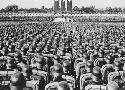
In the past, fascist politics would focus on the dominant cultural group. The goal is to make them feel like victims, to make them feel like they’ve lost something and that the thing they’ve lost has been taken from them by a specific enemy, usually some minority out-group or some opposing nation.
This is why fascism flourishes in moments of great anxiety, because you can connect that anxiety with fake loss. The story is typically that a once-great society has been destroyed by liberalism or feminism or cultural Marxism or whatever, and you make the dominant group feel angry and resentful about the loss of their status and power. Almost every manifestation of fascism mirrors this general narrative.
Part of what fascist politics does is get people to disassociate from reality. You get them to sign on to this fantasy version of reality, usually a nationalist narrative about the decline of the country and the need for a strong leader to return it to greatness, and from then on their anchor isn’t the world around them — it’s the leader.
Fascists are always telling a story about a glorious past that’s been lost, and they tap into this nostalgia. So when you fight back against fascism, you’ve got one hand tied behind your back, because the truth is messy and complex and the mythical story is always clear and compelling and entertaining. It’s hard to undercut that with facts.

"Only those safe from fascism and its practices are likely to think that there might be a benefit in exchanging ideas with fascists.”
I find this next part sadly hilariously true
"Much of American media and press on this side of the Fox News darkness does not dare to call out a fascist. That is partly out of knee-jerk complicity with the culture of leadership and celebrity worship. But I believe that it is also a matter of unbearable fear that the shape of American society, and the practices it has long depended on to maintain some semblance of democracy, are being destroyed, and no one quite knows what to do about it, save hoping to be saved by Mueller and/or impeachment."
we didn't know what to do, and still don't. Mueller and impeachment had no effect on the public discourse. we should stop hoping that engaging with bad faith "arguments" flaunting disregard for the truth in favour of building a narrative of lost glory to be remade through out-group fear and hatred will do anything either.