32 private links
"With interest rates near historic lows, the Bank of Canada doesn’t have much conventional ammunition to fight a major downturn, a problem faced by most other central banks. That’s aggravated by Canada’s extremely high household debt levels, which will make policy makers even more reluctant to lower borrowing costs.
The end result may be a growing reliance on fiscal policy to manage slowdowns, in coordination with the Bank of Canada in a relationship that could be formalized as early as 2021 when the central bank completes a mandate review.
“It’s pretty clear we are reaching limits to what central bankers can do with conventional instruments,” Perrault said. “That’s going to place a premium on policy coordination. We will need somebody that understands the linkages between monetary and fiscal policy, and how coordination between these policies can and should be executed while maintaining the central bank’s independence.”


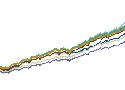
GPU speedup: XGBoost 7.3x, LightGBM 3.6x (excluding goss results), Catboost 3.3x
"while XGBoost can explore its space of hyper-parameters very fast, it does not always locate the configuration that results in the best score. While it clearly wins in both multi-class ranking tasks (Microsoft, Yahoo), for the Higgs dataset it loses to LightGBM, despite the latter being significantly slower. Furthermore, for the Epsilon dataset XGBoost cannot be used due to memory limitations.
... there are tasks for which LightGBM, albeit slower, can converge to a solution that generalizes better. Furthermore, for datasets with a large number of features, XGBoost cannot run due to memory limitations, and Catboost converges to a good solution in the shortest time. Therefore, while we observe interesting trends, there is still no clear winner in terms of time-to-solution across all datasets and learning tasks. The challenge of building a robust GPU-accelerated GBDT framework that excels in all scenarios is thus very much an open problem."

"I decided to go through all 10 analysis sections to decide for myself. And I found that, in five of the 10 areas, Mueller seems to believe that all three criteria to charge a crime are supported by evidence.
- Trump’s conduct toward Paul Manafort’s cooperation
- Efforts to have Donald McGahn deny that Trump tried to fire Mueller
- Efforts to curtail the Mueller probe
- Efforts to fire Mueller
- Conduct involving Michael Cohen"


I’m a social psychologist, so I’m interested primarily in the situational and contextual factors that drive human behavior. When you’re seeking to predict or explain a person’s actions, looking at the social norms, and the person’s context, is usually a pretty safe bet. Situational constraints typically predict behavior far better than personality, intelligence, or other individual-level traits.
So when I see a student failing to complete assignments, missing deadlines, or not delivering results in other aspects of their life, I’m moved to ask: what are the situational factors holding this student back? What needs are currently not being met? And, when it comes to behavioral “laziness,” I’m especially moved to ask: what are the barriers to action that I can’t see?
There are always barriers. Recognizing those barriers— and viewing them as legitimate — is often the first step to breaking “lazy” behavior patterns.

Astronomers are puzzling over a paucity of planets in the galaxy measuring between 1.5 and two times Earth's size.

“This game has the potential to inoculate a generation against misinformation. But it’s such a big problem, how do we meet the size of the challenge? Technology and gamification is a really powerful tool in being able to do that.”

"Carlsen said: “In chess, you know when you’ve done well and when you’ve done poorly, but it’s hard for me to take praise for fantasy league, when I’ve just been lucky.”"

"“Instagram vs. Reality” posts exposing the fake side of Instagram might help body image, suggests a new US study (n=305), which found that unrealistic images with photo editing tools increase women’s body dissatisfaction, but posts exposing these images as fake can improve women’s body image."


120% over target... whoops
"The new documents come as the climate crisis is nearing a tipping point, with average temperatures currently on pace to rise by 3.2 degrees Celsius above the baseline average temperature at the start of the industrial era, according to United Nations projections published in November. A separate study last month found the world’s 10 biggest fossil fuel-producing countries are on course to drill 120% more oil, gas and coal by 2030 than would be consistent with keeping warming within 1.5 degrees Celsius, beyond which scientists project catastrophic change."
how do you interpret the different relationship between the two variables among Democrats and Republicans?